Product and place
What is distinctive, what should stay specific, and which relationships shape what can be carried into public story?
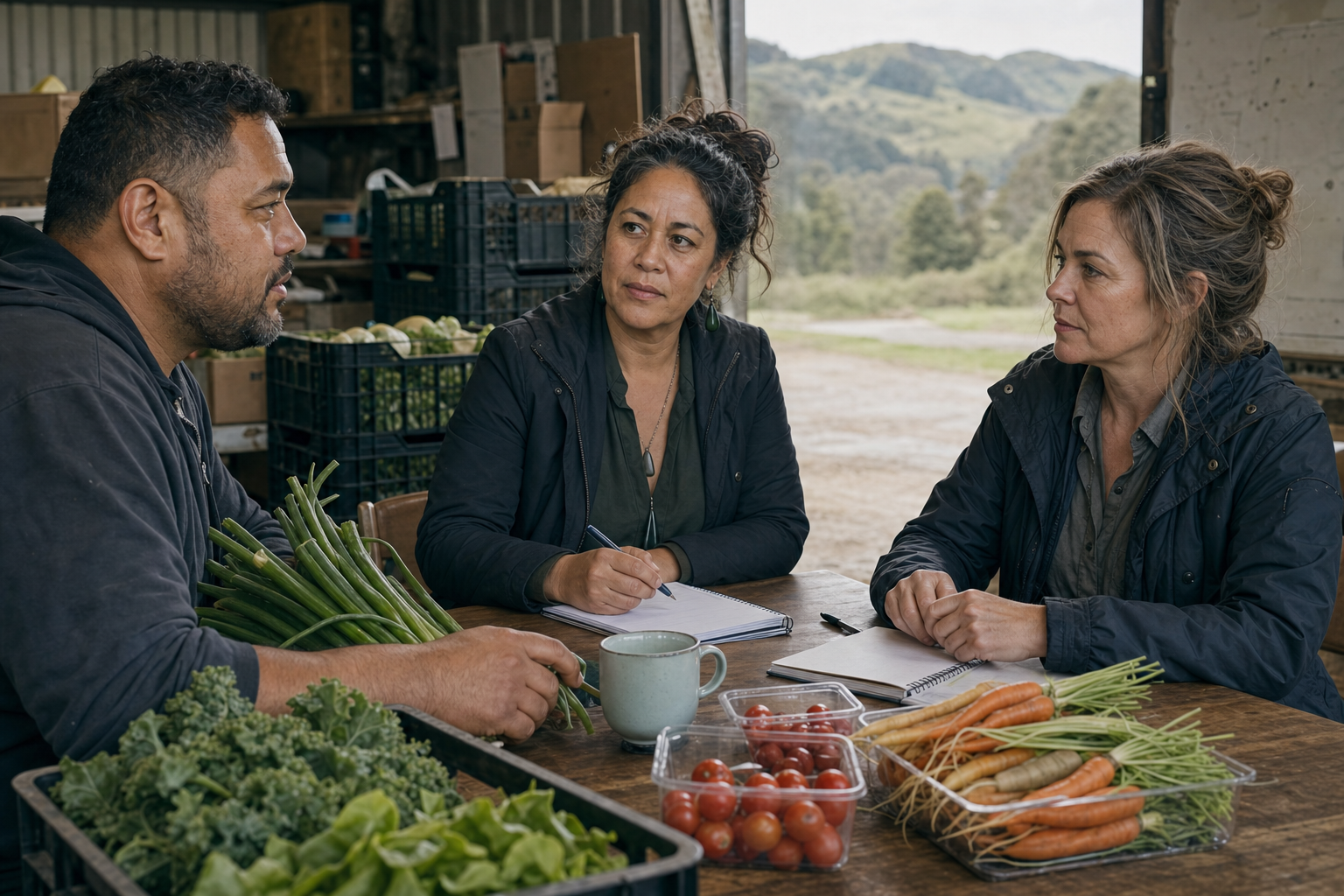
Producer pathways
Aotea Kai works with producers on workflow, evidence, product readiness, logistics, price reality, story-use boundaries, and the question of what kind of growth is actually worth carrying.
How support works
What is distinctive, what should stay specific, and which relationships shape what can be carried into public story?
Where do product quality, labour, timing, packaging, documentation, or storage need strengthening as demand grows?
What claim can be supported now, what needs testing, and what should wait for stronger evidence?
What movement, consolidation, temperature, storage, and handoff requirements make the pathway viable?
Which buyer values the product correctly, and which buyer would make value harder to protect?
Selected pathways
These examples show the breadth of the company: not every pathway is food on a plate, not every pathway takes the same shape, and not every market is the right market.
Pathway focus: strong honey demand, better batch records, and careful use of premium claims.
Aotea Kai role: lab-record workflow, export-ready documentation, packaging discipline, small allocation to Japan and Singapore.
What we are strengthening: proof that protects trust and keeps allocation clear.
Pathway focus: functional ferments and botanical drinks with shelf-life, cold-chain, and wellness-claim requirements.
Aotea Kai role: trial production workflow, chilled route design, buyer testing in Australia, and claim language review.
What we are strengthening: evidence that keeps pace with strong market story.
Pathway focus: premium wine attention and cellar-door pantry products with scarce supply and export interest.
Aotea Kai role: allocation discipline, shared freight, hospitality-channel introductions, story-use guardrails.
What we are strengthening: scarcity as a source of quality, not only a supply constraint.
Pathway focus: early-stage seaweed-derived food ingredients and trial biostimulant interest.
Aotea Kai role: pathway mapping, processing partner search, proof thresholds, careful overseas ingredient conversations.
What we are strengthening: ecological and relationship claims that move with evidence and care.
Pathway focus: frozen prepared specialty foods with labour planning and cold-chain cost.
Aotea Kai role: process-flow redesign, frozen-route consolidation, food-service launch, margin and energy-cost review.
What we are strengthening: process improvement that lets success become repeatable.
Pathway focus: native-botanical teas and skincare-adjacent ingredients with premium market attention.
Aotea Kai role: stability trials, packaging review, evidence thresholds, small buyer test in Korea.
What we are strengthening: place-based story and sustainability language supported by relationship discipline and proof.
What changes
We judge producer support by what changes after the first conversation: better workflow, clearer evidence, stronger route options, clearer market fit, and producers who have more choices rather than fewer.
Packing benches move, batch notes get simpler, labour peaks are named earlier, and producers can see how market commitments would shape the week before they sign up to them.
Claims become easier to check. Testing, origin notes, shelf-life evidence, handling requirements, and product records stop living in scattered memory and start supporting buyer confidence.
The producer stops hearing only "more demand" and starts seeing which channel asks for what: margin, packaging, timing, service level, story, price, data, and reliability.
Small lots become possible when storage, consolidation, pickup timing, chilled movement, and handoff notes are designed around real product needs rather than generic freight convenience.
Producer guide
The producer guide sets out the information we usually need, the readiness questions we ask, and how we pace or select growth when buyer interest is strong.