What we do
We build the middle that lets better markets hold.
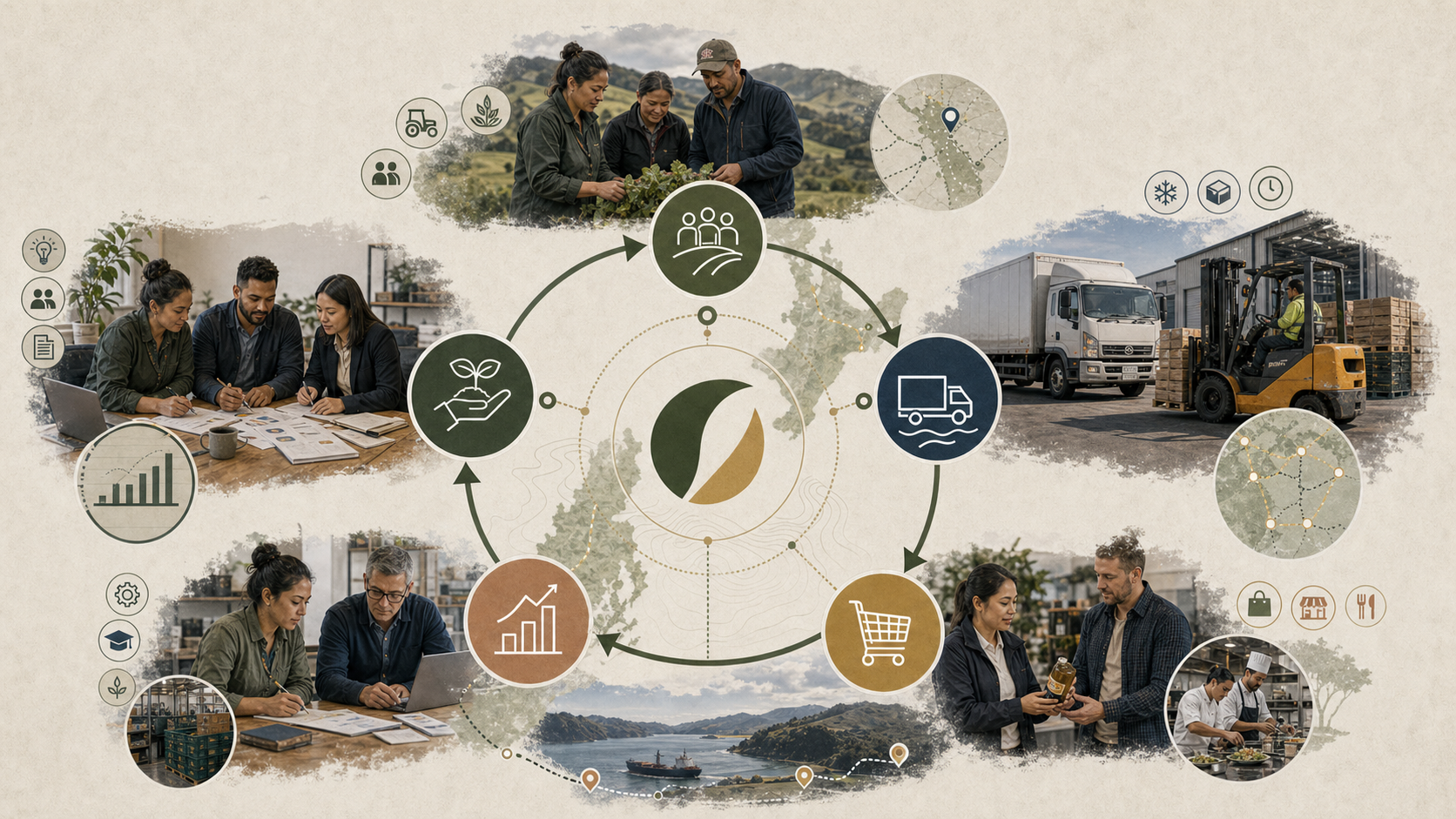
We connect producers to better-fit markets by doing the work between ambition and delivery: readiness, proof, route discipline, market translation, commercial structure, manaaki in practice, and reinvestment that can be felt after the sale.
Difference
The difference is a sequence: prepare, carry, translate, return.
Most producers do not need a slogan from us. They need the right sequence of small improvements: better workflow, cleaner records, more reliable packing, stronger buyer fit, more useful pricing, less friction in the route, and a market that values what is actually distinctive.
Operating model
Six capabilities work together so the model stays strong.
Producer partnership
We begin with what a producer can actually carry: product, people, timing, values, evidence, and appetite for demand.
Value created: better-fit opportunities and clearer support before scale.
Market translation
We translate between producer reality and buyer expectations: category, margin, service level, proof, story, and readiness.
Value created: buyers understand the product without flattening it.
Logistics backbone
We coordinate route design, partner handoffs, consolidation, storage, cold/dry requirements, and export-readiness timing.
Value created: regional producers can reach markets that would otherwise be hard to access alone.
Quality and proof
We help make claims, batch records, provenance, testing, and handling evidence easier to read and harder to misuse.
Value created: public trust and buyer confidence have something to stand on.
Commercial discipline
We test unit economics, buyer concentration, margin, allocation, service cost, and the right pace for each product.
Value created: growth is supported by producers, staff, and systems.
Utu and reinvestment
We direct value back into producer capability, route resilience, systems, product development, relationship practice, and evidence work.
Value created: the network becomes more capable rather than just larger.
Market fit
Aotea Kai grows by being useful in the places ordinary market access is not enough.
We earn our place when the work is complex for a producer to manage alone, relationship-heavy for a standard distributor, proof-sensitive for a loose broker, or values-led beyond a pure volume play.
Mixed revenue, clear boundaries
We can earn through pathway margins, logistics coordination, market development, shared services, and selected category partnerships. The discipline is keeping revenue streams aligned with producer readiness and route quality.
Scarcity can be a strength
Some products are stronger when allocation is tight. We help producers treat buyer enthusiasm as one signal inside a wider growth plan.
Proof lowers market friction
When buyers can see provenance, testing, handling, and value-return logic, they can justify a premium without relying only on story.
Selection protects the network
The company selects channels, timing, claims, and volumes that strengthen long-term trust as well as short-term revenue.
Value loop
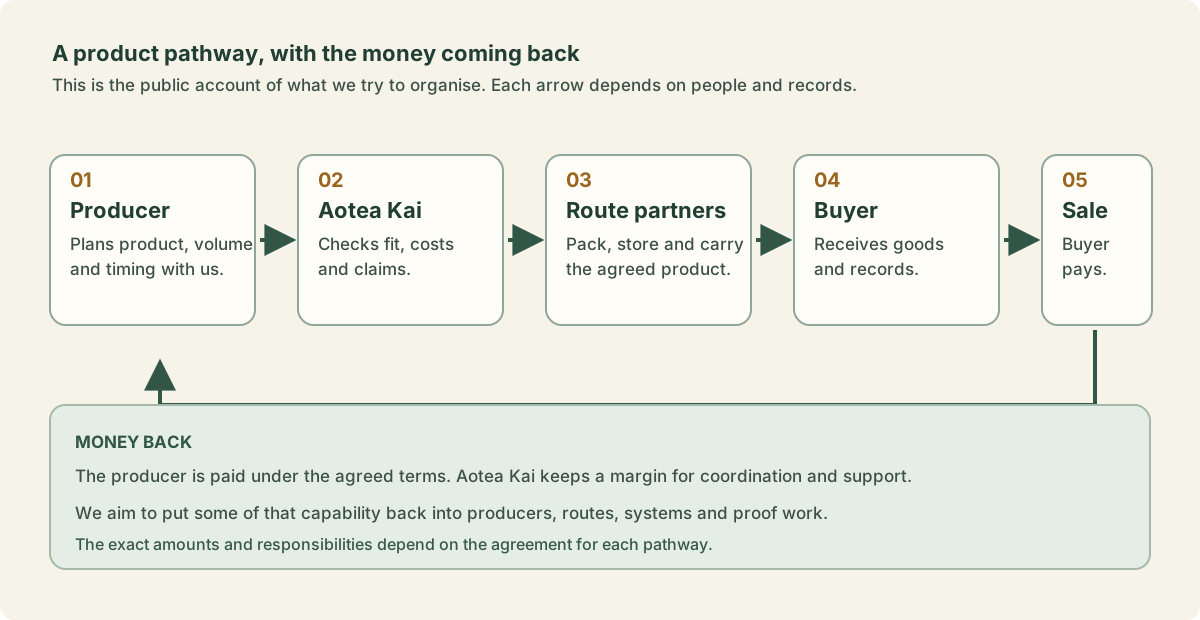
Market access should return capability as well as revenue.
Board questions
The model only works when these questions stay alive.
Every pathway decision moves money, proof, attention, responsibility, and reputation. The work is to make those movements visible early enough to choose well.
What tells us a producer is ready for more demand?
Not enthusiasm by itself. We look for volume shape, workflow strength, quality consistency, packaging and labelling readiness, route tolerance, story comfort, and the producer's own appetite for what growth would ask of them.
When does demand need pacing?
When a buyer's service level, price expectation, proof requirement, timing, or volume demand starts reshaping the product relationship. That is when Aotea Kai paces the deal, reframes the channel, or selects a better-fit path.
How does logistics create value rather than just cost?
Consolidation, cold-chain discipline, stronger handoffs, better dispatch timing, route learning, and clearer route-review records all protect value already created before the product left the producer.
What counts as value returned?
Producer payments are central, but not the whole story. Returned value can also be better capability, stronger systems, reduced waste, clearer evidence, improved terms, local employment, and relationships that still have room to choose.
Readiness points
Our model is strongest when improvement stays visible.
Market desire needs readiness
A strong buyer can make readiness look urgent. The remedy is staged commitment and explicit capacity checks.
Routes reveal cost
Freight, storage, timing, and handling all shape producer value. The remedy is visible route cost and post-run review.
Values need practice
When values language is useful in market, it has to stay connected to relationship discipline, evidence, and pathway selection.
Evidence keeps developing
Perfect proof is rarely available at decision time. The remedy is decision-useful evidence thresholds and clear review.